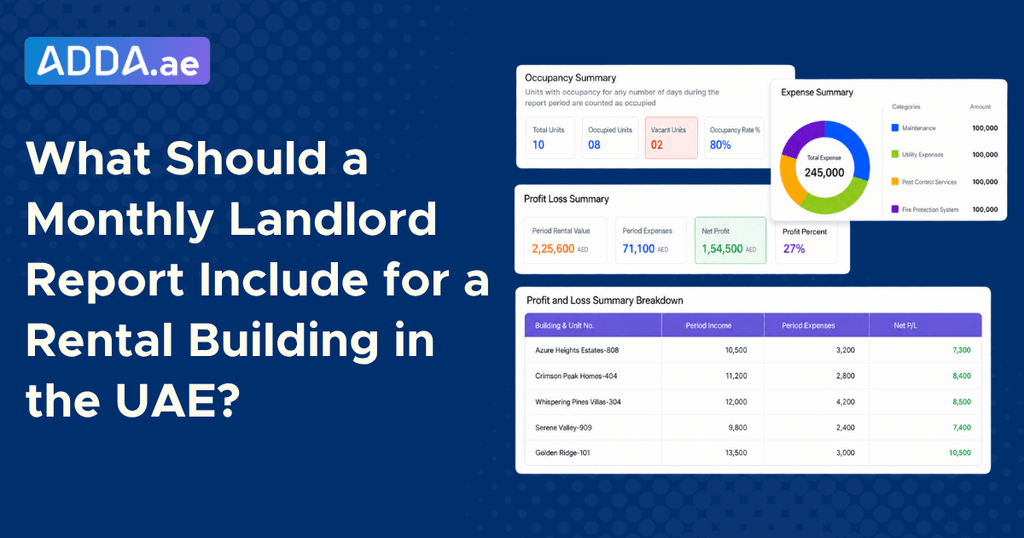
If you own a rental building in Dubai, you probably get a report from your property manager every month. The real question is whether it tells you anything useful.
This guide is written from the owner’s side. It covers what a good monthly landlord report should include, how to read the key numbers, and the warning signs worth catching early.
Quick answer: A monthly landlord report should cover eight things: occupancy, rent billed vs rent collected, unpaid rent and cheque status, expenses by category, net operating income, upcoming lease expiries, maintenance activity, and vacant unit details. Every number should be for a clearly stated period and should match the accounts.
What is a monthly landlord report, and how is it different from an owner statement?
A landlord report is a regular summary of how your rental property performed over a set period. It covers money, occupancy, tenants and upkeep, all in one place.
An owner statement is narrower. It’s a financial record: rent received, deductions such as management fees and repairs, and the amount paid out to you. Think of it like a bank statement for your property.
You need both, but they answer different questions:
| Owner statement | Landlord report | |
| Answers | How much money did I get? | How is my building actually doing? |
| Looks at | Transactions | Performance and trends |
| Includes occupancy and renewals | Rarely | Always |
| Helps you decide what to do next | Not really | Yes |
If your property manager only sends you the first one, you’re seeing the result but not the reasons behind it.
What should a monthly landlord report include for a rental building in the UAE?
A useful monthly landlord report has six sections. Each one answers a question you’d otherwise have to ask your property manager on a call.
- Occupancy summary. How many units you have, how many are leased, how many are empty, and the occupancy rate. It should also say how “occupied” is counted (for example, leased for the full month or for any part of it).
- Rent billed vs rent collected. What tenants owed this month and what actually came in. The gap between the two is the number to watch.
- Expenses by category. Maintenance, utilities for common areas, service charges, management fees, insurance and anything unusual. Big one-off costs should come with a short note.
- Net operating income (NOI). Rent collected minus operating costs. This is the clearest single view of what the building earned.
- Upcoming lease expiries. Which leases end in the next three to four months, what the current rent is, and whether a renewal conversation has started.
- Vacant unit details. For each empty unit: how long it has been vacant, the asking rent, and what’s being done to fill it.
If your report covers all eight, you can understand your building in five minutes without picking up the phone.
How do you calculate occupancy rate, rent collection rate and net rental yield for a UAE property?
These four numbers tell you most of what you need to know. Here’s how each one works, using a simple example.
The example building: 40 apartments in Dubai, valued at AED 60 million. Average rent is AED 100,000 a year per unit. This month, 36 units are leased and 4 are empty.
| Metric | Formula | Example | Result |
| Occupancy rate | Leased units ÷ total units × 100 | 36 ÷ 40 × 100 | 90% |
| Collection rate | Rent collected ÷ rent billed × 100 | AED 285,000 ÷ AED 300,000 × 100 | 95% |
| Gross yield | Annual contracted rent ÷ property value × 100 | AED 3.6M ÷ AED 60M × 100 | 6.0% |
| Net yield | (Annual rent collected − annual operating costs) ÷ property value × 100 | (AED 3.42M − AED 0.7M) ÷ AED 60M × 100 | 4.5% |
The figures are for illustration only. They aren’t market benchmarks.
Why doesn’t 90% occupancy mean a rental building earns 90% of its potential rent?
Occupancy counts units. Income depends on rent actually collected. In the example, the building could earn AED 4 million a year if every unit were leased and every tenant paid on time. It actually collects AED 3.42 million, which is about 85.5% of its potential.
That gap comes from two places: empty units and unpaid rent. A report that shows only occupancy hides the second one. Ask for both.
What are vacancy days, and why do they tell a landlord more than the vacancy rate?
Vacancy days add up how long each empty unit has been empty. Four units empty for 10 days each is a normal turnover. One unit empty for 120 days is a pricing or condition problem. Both can show the same vacancy rate on a given day, which is why the number of days tells you more.
Who pays service charges on a rented property in Dubai, the landlord or the tenant?
If your units sit in a jointly owned building or community in Dubai, the owner pays the service charges, not the tenant. Under Dubai Law No. 6 of 2019, the owner stays liable even if a lease asks the tenant to pay and the tenant doesn’t. These charges are approved by RERA and billed through Mollak.
Your report should show the service charge amount, the period it covers, and whether it has been paid. Unpaid service charges become a debt on the unit.
If you own the whole building outright, the picture is different. Running costs such as cleaning, security, lifts and common-area utilities usually sit with you directly and should appear as separate expense lines.
How does VAT affect a landlord’s expenses on a UAE residential rental?
Long-term residential rent in the UAE is exempt from VAT. That also means a landlord generally can’t recover the VAT paid on related costs such as maintenance, repairs and management fees. So your report should show expenses including VAT, because that VAT is a real cost to you.
Commercial units, such as shops on the ground floor, are different. Rent on those is charged at 5% VAT. If your building is mixed-use, ask for residential and commercial income to be shown separately.
Do individual landlords pay corporate tax on rental income in the UAE?
For individual owners, rental income from UAE property held in your personal name, without a business licence, is generally outside the scope of UAE corporate tax. Income earned through a company or a licensed business is treated differently. (source) Your report doesn’t need to calculate tax, but it helps if it’s clear which entity the income belongs to. Check your own situation with a tax adviser.
What red flags should a landlord look for in a monthly property management report?
You don’t need to read every line every month. Scan for these seven signs instead.
- The collection rate is slipping. Occupancy looks steady but less rent is coming in. That usually means unpaid rent is building up.
- The same tenant keeps showing up as late. One late payment happens. Three in a row is a pattern that needs a conversation.
- One unit keeps dragging profit down. If the per-unit breakdown shows the same unit at the bottom every month, look at its rent, condition or maintenance history.
- A vacancy that won’t close. An empty unit past 60 days usually points to the asking rent, the condition of the unit, or how it’s being marketed.
- Renewals coming up with no plan. If a lease ends within 90 days and the report doesn’t say whether rent is changing, you may already be too late to change it. In Dubai, rent changes at renewal need written notice at least 90 days before the lease ends.
- The numbers don’t match last month’s. If the opening figures this month don’t line up with last month’s closing figures, ask why before you rely on anything else in the report.
None of these are emergencies on their own. They’re prompts to ask a question before a small issue becomes an expensive one.
Should landlord reports be monthly, quarterly or annual for a rental building?
Monthly is the standard for a rental building, with a fuller quarterly and annual view on top. Each one does a different job.
| How often | What it’s for | What to focus on |
| Monthly | Catching problems early | Collections, bounced cheques, vacancies, open maintenance |
| Quarterly | Seeing trends | Occupancy over three months, expense patterns, renewals coming up in the next quarter |
| Annually | Making big decisions | Net yield, total costs, rent levels against the market, capital work for next year |
One thing matters more than how often: every report should use the same format. If the layout changes from month to month, you can’t compare one month with another, and comparing is the whole point.
Should a landlord report be prepared in Excel or generated by property management software?
A good landlord report is only as reliable as the data behind it. When it’s put together by hand from separate spreadsheets for leases, rent, cheques and expenses, the numbers can drift apart. The layout also tends to change depending on who built it that month.
When leases, rent collection, cheques and expenses all sit in one system, the report comes straight from the same records the accounts use. You get the same format every month, and the numbers match.
That’s the thinking behind automated landlord reports in ADDA Rental Manager. Operators of rental buildings across the UAE use it to send owners a consistent monthly report without rebuilding it each time.
Want to see what a consistent monthly landlord report looks like for your building? Talk to the ADDA team.
Frequently asked questions
What is the difference between a landlord report and an owner statement?
An owner statement lists the money: rent received, deductions and the amount paid to you. A landlord report shows how the property is performing, including occupancy, unpaid rent, expenses, upcoming renewals and vacant units.
What is a good occupancy rate for a rental building in Dubai?
It depends on the area, the building and the time of year, so there’s no single right number. The more useful check is your own trend. If occupancy is falling while nearby buildings are full, look at your pricing and unit condition.
How do I calculate net rental yield in the UAE?
Take your annual rent collected, subtract your annual operating costs (service charges, maintenance, management fees and insurance), then divide by the property’s value and multiply by 100. Use rent actually collected, not rent on paper.
Should service charges appear on my landlord report?
Yes. In Dubai’s jointly owned buildings, the owner is responsible for RERA-approved service charges, even if a lease passes them on to the tenant. Your report should show what’s due and whether it’s been paid.
Do landlords pay VAT on residential rent in the UAE?
No. Long-term residential rent is exempt from VAT. Rent on commercial units is charged at 5%. Because residential rent is exempt, VAT on related costs usually can’t be recovered, so count it as part of your expenses.
How should bounced rent cheques show on a landlord report?
As their own line, separate from general unpaid rent. Each one should show the tenant, the amount, the date and what’s being done to recover it.
How often should a property manager send a landlord report?
Monthly for day-to-day tracking, with a quarterly summary for trends and an annual review for bigger decisions such as rent levels and capital work.
What should a landlord report say about upcoming renewals?
It should list every lease ending in the next three to four months, the current rent, and whether a decision on the new rent has been made. In Dubai, changing the rent at renewal needs written notice at least 90 days before the lease ends, unless the lease itself says otherwise.