In every residential community across the UAE, daily life runs on one thing: how quickly problems actually get fixed.
A leaking pipe. A faulty lift. A broken light in the parking basement. These aren’t “minor inconveniences.” They hit comfort, safety, and , if left unaddressed , they quietly erode resident trust in the Owners Association Management (OAM) running the building.
But here’s the question nobody asks enough:
What actually happens between a complaint and its closure?
That journey , from the moment a frustrated resident picks up their phone to the moment the issue is marked resolved , is where the real community experience is made or broken. And it’s exactly where ADDA Helpdesk (ADDA Desk) changes how communities operate.
What Life Looks Like Without a Structured Helpdesk
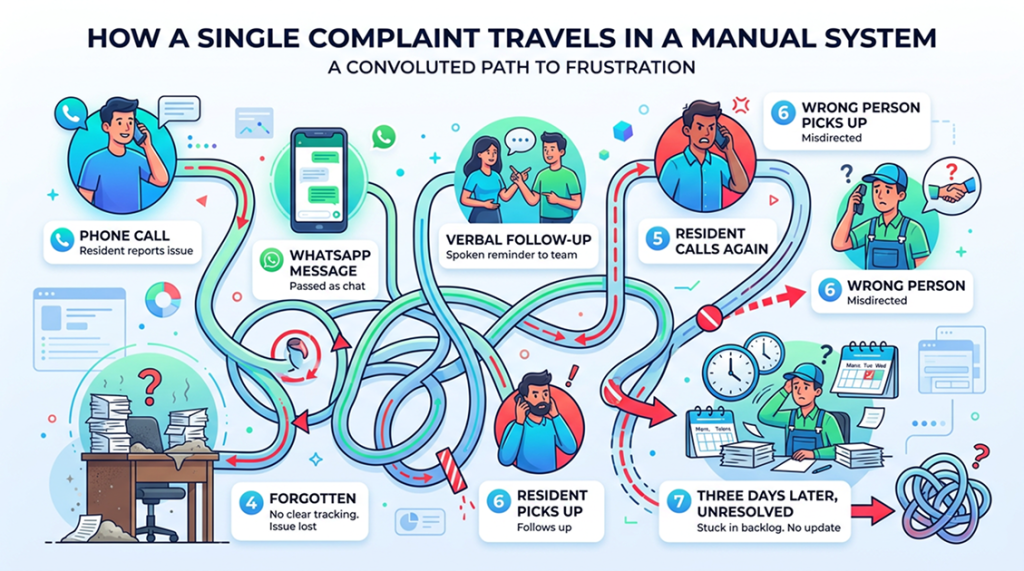
Most communities in the UAE still run on a mix of phone calls, WhatsApp groups, verbal conversations in the lobby, and maybe a spreadsheet someone updates when they remember. It works. Until it doesn’t.
The moment a community crosses a certain size, things start slipping.
What Residents Experience
- No clear idea of who to actually call
- Having to follow up the same issue two, three, sometimes four times
- Zero visibility on what’s happening with their request
- Delays because the right person was on leave and nobody picked it up
- The frustrating silence of not knowing whether anyone even saw the complaint
A straightforward water leakage can turn into a three-day back-and-forth purely because nobody tracked it when the facility manager was out.
What OAMs Experience
- No real view of how staff time is being used
- No way to spot recurring issues before they become expensive problems
- No SLA tracking, so there’s no accountability when things drag
- No structured escalation , urgent issues get buried alongside minor ones
- No data to show at meetings or present to residents
The result is predictable: chaos, finger-pointing, rising dissatisfaction, and a committee that’s always playing catch-up.
Why UAE Residential Communities Need Something More Structured
Modern residential communities in the UAE ,especially the larger developments ,operate more like mini-cities than apartment buildings.
You have plumbing teams, electrical staff, housekeeping, security operations, external contractors, and specialist vendors, all needing to coordinate constantly. Residents meanwhile have grown up with digital-first services. They expect the same responsiveness from their community management that they get from food delivery apps and online banking.
Without a proper system tying it all together, complaints slip through the gaps. And every time that happens, trust takes a quiet hit.
How ADDA Helpdesk Actually Changes Things
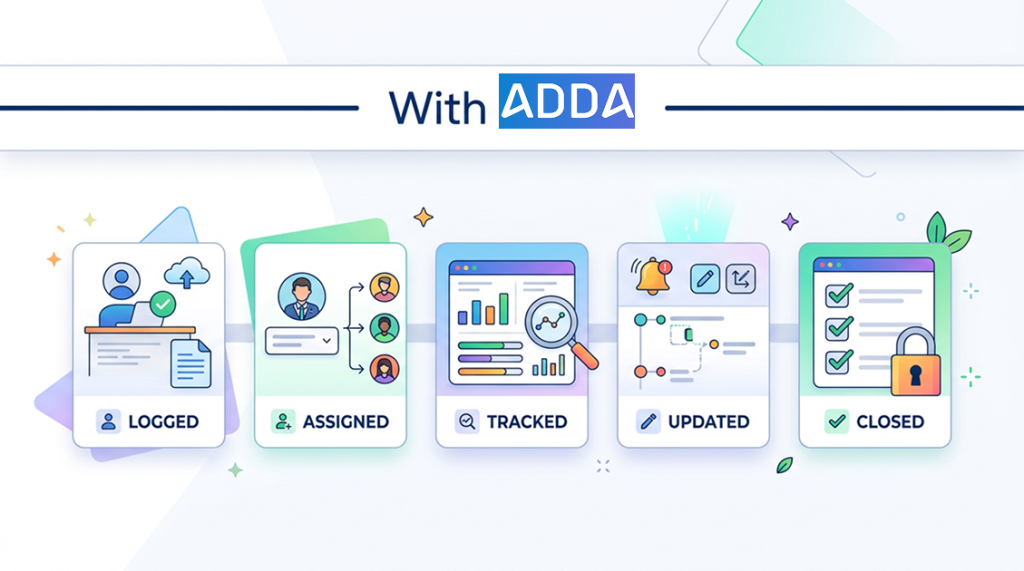
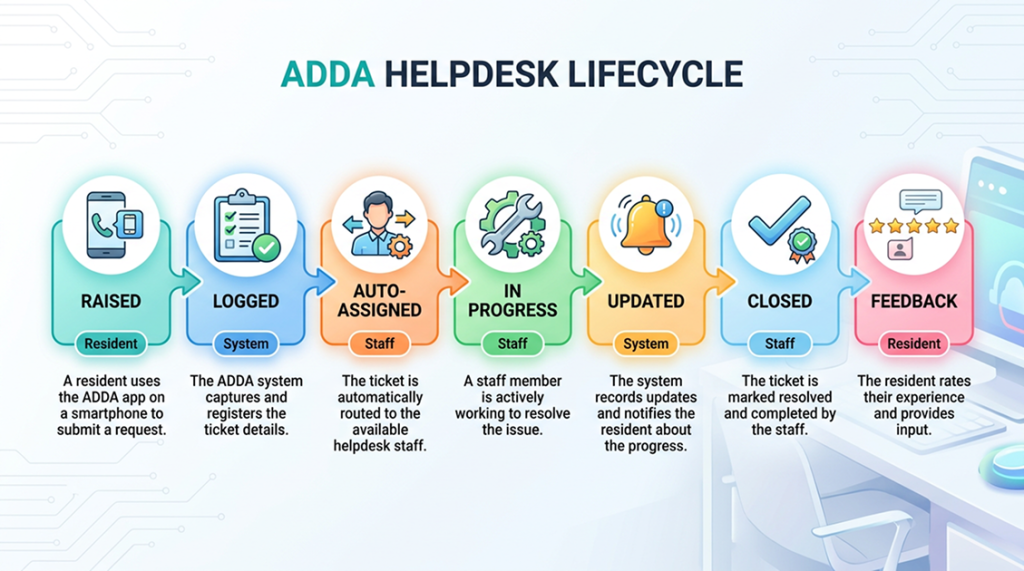
ADDA Desk brings structure, transparency, and a clear process to what is usually a messy, informal operation. Every complaint stops being a message floating around someone’s inbox and becomes something trackable:
Logged → Assigned → Tracked → Updated → Closed with feedback
Here’s what that looks like in practice.
1. Raising a Complaint Shouldn’t Be Complicated
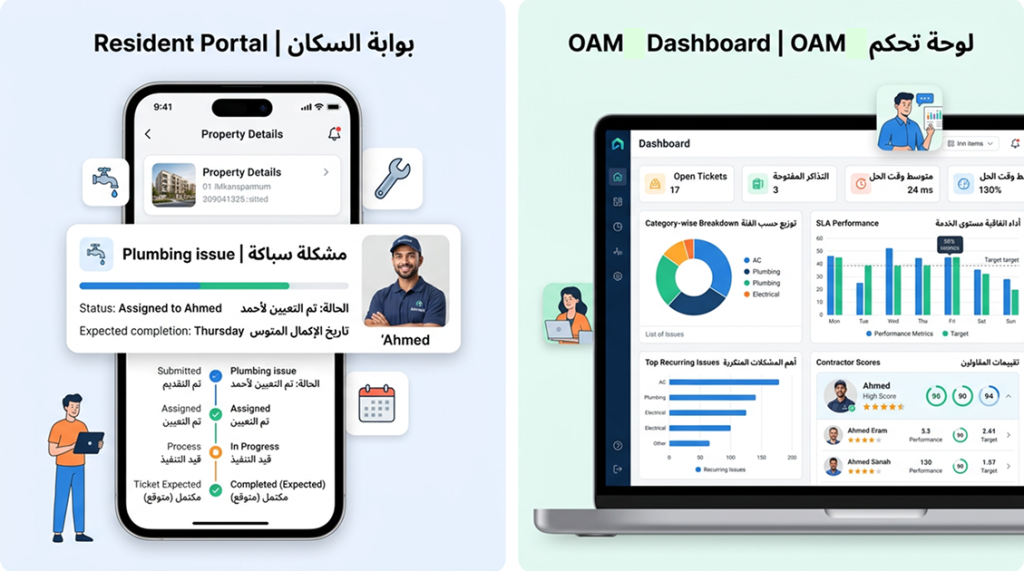
With ADDA, residents can raise tickets through the app in seconds. They can add photos to make the issue clear, use voice input, and specify when they’re available for the work to happen. No hunting for a phone number. No wondering which WhatsApp group to post in.
AI-powered ticket creation handles the categorization automatically, so the right team gets it from the start. Older residents or those less comfortable with technology can still participate just as easily.
2. Automatic Routing , So Nothing Gets “Lost”
Once a complaint is raised, it’s instantly assigned to the right category: plumbing, electrical, housekeeping, security. The right team member gets it directly. Nobody needs to manually triage a list of incoming requests every morning.
This alone eliminates the most common excuse in community management: “I didn’t receive that message.”
3. Real-Time Updates Mean Residents Stop Chasing
Nobody should have to call three times to find out whether their issue is being looked at.
With ADDA Desk, residents get automatic status updates, technician assignment details, photos of completed work, and service schedule notifications , all within the app. Two-way communication happens inside the ticket itself, not scattered across WhatsApp threads that nobody can search later.
4. Staff and Vendors Are Actually Accountable
Every action is time-stamped. Staff update tickets with notes and images as work progresses. Vendors only see the tasks assigned to them. Access is role-based. Escalations trigger automatically when timelines are missed.
No lost complaints. No “it fell through the cracks during handover.” No vague answers when a resident asks what happened.
5. Full Visibility for OAMs
This is where things get genuinely useful for management.
Instead of relying on gut feel or whoever complained loudest at the last meeting, OAMs get:
- Category-wise issue trends over time
- Staff utilization and workload reports
- Turnaround time tracking against SLAs
- Satisfaction scores from residents post-resolution
- Contractor performance data
With that kind of visibility, communities can stop being reactive and start being proactive. Spot a recurring plumbing issue in Block C? Investigate before it becomes a major repair bill. Notice one vendor consistently missing deadlines? Deal with it early instead of at the AGM.
6. Escalation Paths for Emergencies
Water leakages, electrical hazards, security faults , these can’t sit in a queue. ADDA Desk auto-escalates emergency complaints if they aren’t picked up within defined timeframes, so serious issues don’t stay buried in an inbox while someone’s away from their desk.
7. Paid Services and Revenue Transparency
Communities can also publish paid in-unit services through the platform , allowing residents to book and pay within the app, with completion tracked and accountable. No cash confusion. No informal contractor arrangements nobody can trace later.
The Shift That Actually Matters
Here’s something most communities don’t realize until they’ve made the switch: the real impact isn’t about the software. It’s about what stops happening.
Residents stop chasing. They raise an issue, get an acknowledgment, and actually trust that something is moving. That’s a genuinely different experience from what most people are used to ,where raising a complaint often feels like shouting into a void and hoping someone eventually shouts back.
Staff have a totally different day too. Instead of fielding the same follow-up call four times, or trying to remember which WhatsApp message was about the parking light and which was about the lift, they work off a clear task list with deadlines they can actually see. Communities that have made this switch report saving well over 40% of the time previously swallowed by manual coordination. Not a small thing.
And for OAMCs, the governance angle alone is worth the conversation.
When every complaint, every assigned task, and every resolution carries a timestamp, the tone at AGMs shifts. “Nothing ever gets fixed here” is a lot harder to argue when there’s a dashboard showing 94% of tickets closed within SLA last quarter. Budget decisions stop being about who made the most noise in the lift and start being about what the data actually shows. That move ,from gut feel to evidence , is one of the most underrated benefits of the whole system, and it rarely gets talked about enough.
Complaint → Ticket → Assignment → Update → Closure → Feedback
That flow ,simple as it looks on paper , changes daily community life in ways that are hard to appreciate until you’ve lived on both sides of it.
Arguments become trackable processes. Frustration gets a resolution path. And the committee that was always one complaint away from a meltdown becomes a team that can actually point to what they’ve done.
Why This Matters for UAE Communities Right Now
Residential developments across the UAE keep getting bigger and more complex, and the bar for professional community management keeps rising with them. Residents expect more. Regulators are paying more attention. Developers are being held to higher standards post-handover.
Running complaint management on goodwill and WhatsApp wasn’t sustainable five years ago. It’s really not sustainable now.
If your community is still piecing things together informally, it might be worth seeing what a structured system actually looks like in practice.
Explore ADDA for UAE Community Life
FAQs
What is a community helpdesk and why does it matter in the UAE?
It’s a platform where residents raise issues, track what’s happening with them, and get updates without having to ask ,while management gets full visibility into what’s open, what’s overdue, and where the patterns are. In larger UAE communities especially, the old approach of phone calls and WhatsApp threads just stops working past a certain point.
How is ADDA Helpdesk different from managing complaints on WhatsApp?
WhatsApp has no ticketing, no trail, no SLA tracking, no way to assign tasks cleanly, and no data. A complaint on WhatsApp is only as safe as whoever last read the message. ADDA logs everything, routes it to the right person automatically, and keeps both residents and management in the loop, no chasing needed.
Can residents actually track their complaints in real time?
Yes. Once a ticket’s raised, they get updates at each stage ,who it’s been assigned to, when work’s happening, when it’s done. All inside the app. No need to call anyone.
Does this work for large gated communities with multiple buildings?
That’s exactly what it’s built for. Multiple buildings, multiple teams, external vendors, layered reporting ,it handles the complexity without needing everything to go through one person’s phone.
How does this help Owners Associations run more transparently?
Everything is documented. OAMCs can pull dashboards showing response times, recurring issues, and how contractors are performing. It’s a lot easier to govern , and defend when there’s a clear record of what happened and when.