Spend enough time around Dubai’s residential towers and master communities, and you’ll start noticing a pattern.
No Owners Association jumps straight into a full-blown management system. They grow into one, usually the hard way.
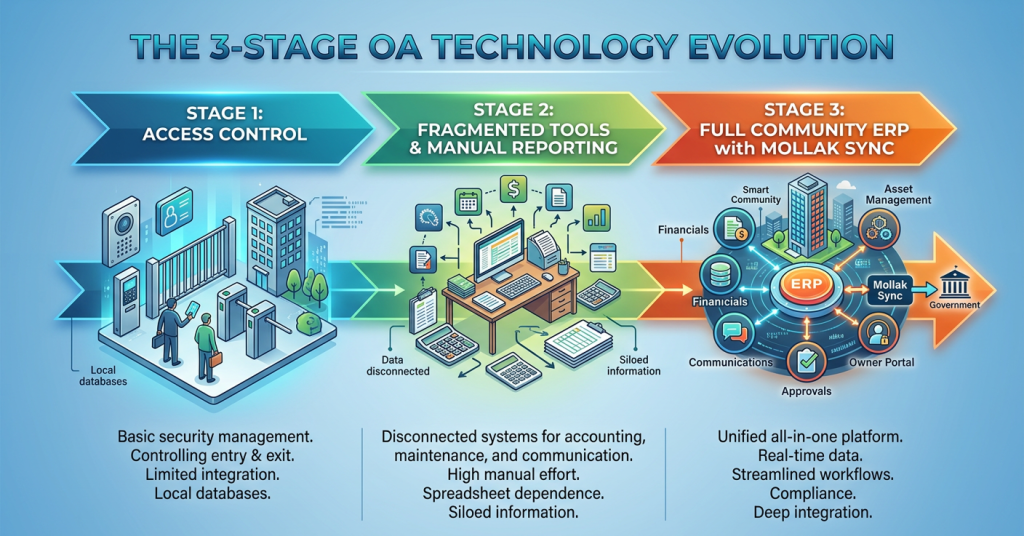
Early on, the OA Manager is putting out one fire: who’s coming through the gate. Later, once the tower or community fills up and the OAM company is knee-deep in service charges, Mollak filings, and resident complaints, gate security stops being the hard part.
Across communities we’ve worked with from single towers in JLT to sprawling master developments in Dubai South , the journey tends to follow the same three stages.
Some OAM companies move through all three within a year of handover. Others get stuck in Stage 1 for years, running on WhatsApp groups and Excel sheets, wondering why service charge collection never seems to improve.
Here’s how it usually plays out.
Table of Contents
- Why Do Newly Handed-Over Communities First Adopt Access Control Systems?
- What Operational Pressure Do OA Managers Face as a Community Fills Up?
- Why Do Mature Owners Associations Move to Full Community ERP Platforms?
- Which Stage Is Your Community In Right Now?
Why Do Newly Handed-Over Communities First Adopt Access Control Systems?
The moment a tower or villa community gets handed over and residents start moving in, there’s one question on everyone’s mind: who’s coming in and out of the building?
Delivery riders, domestic help, contractors finishing snagging work, visiting family, every single one needs to be logged. Security guards at the barrier need something better than a paper register and a walkie-talkie.
So the first thing most OAM companies bring in is a visitor and access management tool.
These systems digitise the front desk. Residents get a notification the second a guest or delivery arrives, and they can approve or deny entry straight from their phone. No more guards calling up ten flats trying to confirm a delivery.
For a freshly handed-over community, this genuinely solves the loudest problem in the room.
A lot of these access tools also come in cheap, sometimes practically free, bundled with hardware and a SIM card, sold on the promise of “digitising your gate in a week.”
If all you need right now is a working barrier and a visitor log, it does the job.
But once occupancy climbs past a few hundred units and the OAM company starts actually running the community, service charges, Mollak reporting, vendor contracts, resident disputes, the gate stops being the whole story.
What Operational Pressure Do OA Managers Face as a Community Fills Up?
Once a tower or master community reaches full occupancy, managing it stops feeling like security work and starts feeling like running a mid-sized business.
The OAM company suddenly owns half a dozen problems that a gate app was never built to solve.
- Service charge billing and collections become a monthly grind. Every unit owner needs an invoice, payments have to be reconciled, and defaulters flagged before they snowball – good luck doing that cleanly on a spreadsheet once you’re past 200 units.
- Vendor payments and budget approvals pile up fast. Facilities management contractors, MEP vendors, landscaping teams, pool maintenance – every one of them sends invoices that need checking against the approved OA budget before anything gets paid.
- Complaint and helpdesk management turns into its own department. Leaks, AC breakdowns, parking disputes, common-area snagging, miss the SLA on even a few of these and owner satisfaction scores start sliding.
- Facility bookings get messy as more residents want the gym, the pool deck, or the multipurpose hall. Without a proper booking system, double-bookings and arguments over “who reserved it first” become a weekly occurrence.
- Owner communication turns into a logistics challenge of its own — announcements, service charge reminders, Mollak-related notices, all going out to hundreds or thousands of unit owners, some of whom don’t even live on-site.
- Governance and compliance responsibilities kick in too. Annual General Meetings have to be conducted under the Jointly Owned Property regulations, budgets need owner sign-off, and financial records have to be audit-ready and Mollak-compliant at any given moment.
This is usually the point where OAM companies realise a tool built purely for visitor approvals just doesn’t have the depth to run all of this.
A few frustrations show up almost every time:
- Free or low-cost access apps clutter the resident communication channel with ads and third-party offers, and important service charge notices get buried under them.
- Financial reporting on these bundled tools is thin at best – accountants end up exporting raw data into Excel just to build a report Mollak or an auditor would actually accept.
- Operational information scatters across email, WhatsApp, and spreadsheets, partly because residents themselves start avoiding the spammy access app.
- Something as basic as a digital vote for an AGM, or generating a Mollak-ready budget report, needs a workaround or a manual process nobody enjoys.
This is usually the moment the OAM company decides the community needs something more structured and Mollak compliance stops being optional and starts being the deadline that forces the conversation.
Why Do Mature Owners Associations Move to Full Community ERP Platforms?
Once a community hits this stage, the question in board and OAM meetings changes shape entirely.
It’s no longer “how do we manage the gate?” It becomes “how do we run this entire Owners Association without it eating our whole week?”
A community with a few hundred or a few thousand units generates a serious volume of activity: financial transactions, service requests, vendor coordination, Mollak submissions, and governance decisions, all needing to be tracked properly and defensibly.
This is where a full community ERP earns its place.
- It’s built to run every function of a UAE residential community, access, finance, operations, governance as one connected system instead of five disconnected apps.
- Financial management becomes structured. Service charge billing, collections, defaulter tracking, VAT-ready accounting, and audit-ready records all live in one place.
- Complaint and helpdesk management gets organised – owners raise a request, the OAM team assigns it to the right vendor, and everyone can see where it stands until it’s closed.
- Communication gets cleaner because announcements go out in a focused channel, not one competing for attention with delivery ads.
- Governance tools let the OA run digital voting, conduct AGMs properly, and keep a clean paper trail of every decision, exactly what regulators expect under UAE’s Jointly Owned Property framework.
- Operational visibility improves too. OAM companies can pull up finance, complaint, and facility-usage reports on demand instead of compiling them by hand before every board meeting.
This is the stage where most serious OAM companies in the UAE move to a dedicated platform like ADDA.
ADDA’s Community Management Software
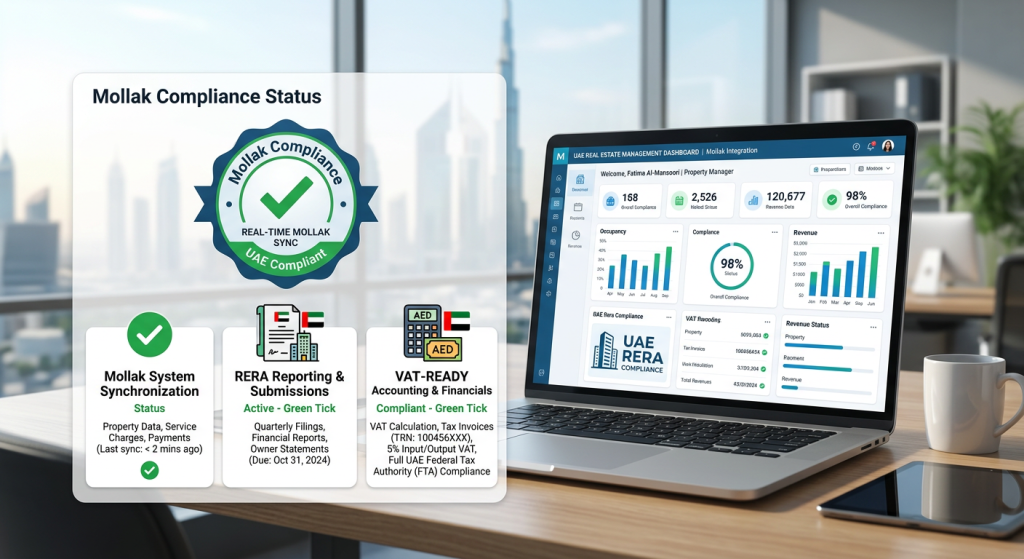
was built specifically for how Owners Associations operate in this market , with real-time Mollak sync, RERA-aligned reporting, and VAT-ready accounting baked in, not bolted on. Instead of stopping at gate entry and notifications, it pulls communication, finance, operations, and compliance into a single system.
For OAM companies, that means the entire community like one tower or an entire portfolio can run on a single platform that was actually designed for UAE regulations, not adapted for them after the fact.
Which Stage Is Your Community In Right Now?
Look honestly at the community you manage, and you’ll probably spot one of these three stages straight away.
Most communities start with a simple access control tool. That’s a fair, sensible first move.
But as occupancy grows and Mollak, RERA, and owner expectations start piling up, the cracks in a gate-only tool become impossible to ignore.
Running a residential community with hundreds or thousands of owners takes a system that actually handles finance, operations, communication, and compliance in one place not five apps stitched together with hope.
The question every OAM company eventually has to answer is a simple one:
Are you still running Stage 1 tools while trying to deliver Stage 3 governance and compliance?
OAM companies that move to a mature platform earlier tend to notice the same handful of changes:
Financial and service records get organised, so operational transparency actually improves instead of being a quarterly scramble.
Manual admin work drops, because a lot of what used to be someone’s full-time job gets automated.
Complaint resolution speeds up because every request is tracked from the moment it’s raised.
Owners start trusting the system more once communication and governance stop feeling like a black box.
Mollak reporting and audits get noticeably less painful for the accounts team.
That’s why a growing number of OAM companies across Dubai and the wider UAE now run their communities on platforms like ADDA.
Because past a certain size, managing an Owners Association isn’t a side task anymore it starts looking a lot like running a proper company. And like any company, it needs systems built for the job, not patched together around one.